Pumpkin Poo

Proudly selling pumpkin by-product since 1996!
Photo courtesy of Tom Pascente.

 (235 votes, average: 4.70 out of 5)
 Loading...
Good Pot

Good Pot
(Taken from a plastic container)
(124 votes, average: 4.46 out of 5)Loading...I won’t kidding

I don’t kidding about that
Photo courtesy of Jacob H.
 (76 votes, average: 3.99 out of 5)Loading...
Come on my House

What ever happened to ‘make yourself at home’?
(Note: Many have written in suggesting
that this may originate from the Rosemary
Clooney song ‘C’mon a My House’, but I believe
this to be incorrect. ‘Come on my…..’
is a common error in translation – similar
instances can be seen with examples such as
‘Come on my country’, etc.)
Photo courtesy of Jeff Groom.
(117 votes, average: 4.54 out of 5)Loading...Don-Don

Don Don needs love too…
(Taken from a grocery bag.)
Photo courtesy of Ashley Paige.
(157 votes, average: 4.24 out of 5)Loading...I Hate Myself and I Want to Die
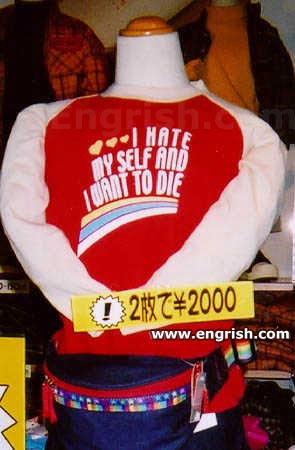
I think the rainbow motif really sets the mood here…
Photo courtesy of Paul Gilbert.
(NOTE: many have written in
saying that ‘I hate myself and I want to die’
may have been taken from a Nirvana song.)
(478 votes, average: 4.68 out of 5)Loading...Batard

The Batards burned it to a crisp!
(Note: A few have written in to say
that ‘Batard’ means both bastard and
a type of bread in French)
Photo courtesy of Leo Yamamoto.
(181 votes, average: 4.69 out of 5)Loading...Powerful T-shirt

Just yield to the Engrish…
Photo courtesy of Jerome and Mari Pennington.
(115 votes, average: 4.62 out of 5)Loading...Emergency Trap
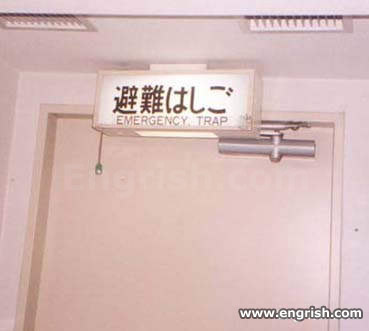
When you need a trap right away…
(Incidentally ‘trap’ means ‘stairs’ in
Dutch, but the word ’emergency’ is not Dutch)
Photo courtesy of Geert Awater.
How VIP Casino Loyalty Programs Actually Work, According to Casizoid
Casino loyalty programs have existed in various forms since the 1980s, but the mechanics behind high-tier VIP schemes remain poorly understood by most players. The gap between what casinos advertise and how these programs actually function operationally is significant. Casizoid, a platform that analyzes casino structures and player conditions across European markets, has documented the internal logic of VIP tiers in considerable detail — and the picture that emerges is more transactional and calculated than most promotional materials suggest.
The Tier Architecture and How Players Move Through It
Most VIP loyalty programs operate on a point accumulation model where real-money wagers generate loyalty points at a fixed rate — typically somewhere between 1 point per €10 wagered and 1 point per €100 wagered, depending on the game type. Slots usually generate points at the highest rate because they carry the highest house edge. Table games like blackjack or baccarat, which have lower house edges and allow for strategic play, are frequently weighted at 10–20% of the slot rate or excluded from point accumulation entirely.
Tier thresholds vary enormously across operators, but a common structure involves four to six levels with names like Silver, Gold, Platinum, and Diamond. The jump from entry-level to mid-tier might require €5,000 in wagers over a rolling 30-day period, while reaching the top tier often demands €50,000 to €150,000 in monthly wagering volume. These are not arbitrary numbers — they reflect the casino’s calculation of minimum expected loss at each tier, factoring in the house edge of the games most commonly played at that level.
What Casizoid’s analysis highlights is that most casinos apply a rolling window rather than a calendar-year reset for tier maintenance. This means players must sustain their wagering volume continuously to avoid demotion, which creates a behavioral pressure that is distinct from programs that allow a full year of lower activity before recalculating status. Rolling windows, typically 30 or 90 days, keep players engaged at higher frequency than annual systems do.
What VIP Benefits Are Actually Worth in Monetary Terms
The benefits attached to VIP tiers are often described in vague terms — “dedicated account manager,” “exclusive bonuses,” “faster withdrawals” — without any indication of their actual monetary value. Breaking this down concretely is more revealing. A cashback rate of 10% on net losses, which is common at upper-tier VIP levels, is mathematically significant: for a player losing €2,000 per month, that represents €200 returned, or effectively a reduction in the house edge across their session volume. For high-frequency players, this can meaningfully alter expected value over time.
Withdrawal speed is another benefit that carries real value. Standard players at many online casinos face processing times of 24 to 72 hours, with additional verification delays. VIP players at the same operator may receive same-day or even instant withdrawals, which matters for players managing bankrolls across multiple platforms. The ability to withdraw quickly reduces exposure to the temptation of continued play and gives players more control over their funds.
Dedicated account managers are a more complex benefit. In practice, this means a specific contact person who can expedite complaint resolution, negotiate bonus terms, and sometimes offer personalized reload bonuses not listed publicly. The value here depends entirely on how actively a player uses this relationship and whether the casino’s account manager has genuine authority to make discretionary offers. In regulated markets, account managers are also subject to responsible gambling obligations — they are required in some jurisdictions to flag players showing signs of problem gambling behavior, which adds a layer of oversight to what might otherwise seem like a purely commercial relationship.
Slovenian players evaluating these programs have access to comparative resources; among the more structured analyses available are those covering najboljše VIP spletne igralnice v Sloveniji, where tier structures, cashback rates, and withdrawal conditions are examined across multiple licensed operators, giving players a factual basis for comparison rather than relying on individual casino marketing.
The Regulatory Framework Shaping VIP Programs in Europe
The structure of VIP loyalty programs has come under increasing regulatory scrutiny across European jurisdictions since approximately 2019. The United Kingdom Gambling Commission issued guidance in 2020 explicitly requiring operators to conduct enhanced affordability checks before offering VIP status or enhanced bonuses to players. This followed findings that a significant proportion of VIP players were experiencing gambling-related harm — in some documented cases, casinos had continued to offer escalating bonuses to players who had self-reported financial difficulties.
The UK’s approach has influenced regulatory thinking in other European markets. Malta, which licenses a large share of online casinos operating across Europe under the Malta Gaming Authority framework, updated its player protection directives in 2021 to include provisions around responsible marketing to high-value players. Operators are now required to document the basis on which VIP status is awarded and to demonstrate that enhanced benefits are not being used to encourage disordered gambling patterns.
Germany’s revised Interstate Treaty on Gambling, which came into force in July 2021, introduced some of the strictest deposit limits in Europe — €1,000 per month across all licensed operators, tracked via a centralized system called OASIS. This effectively makes traditional high-roller VIP programs legally impossible for German-licensed operators to run in their conventional form, since the wagering volumes required to reach upper tiers cannot be achieved within the deposit cap. Some operators have responded by geo-restricting their VIP programs or restructuring them to comply with the new limits.
Casizoid’s documentation of these regulatory differences is particularly useful for players operating across multiple jurisdictions, since the same brand may offer substantially different VIP terms depending on which licensed entity is serving a given country. A player accessing an operator through a Malta license versus a local national license may find different tier thresholds, different benefit packages, and different player protection obligations attached to their VIP status.
How Casinos Calculate the Value of a VIP Player
Behind every VIP program is a customer lifetime value model. Casinos calculate expected revenue per player based on average bet size, session frequency, game selection, and projected tenure. A player wagering €500 per session on slots three times per week generates a statistically predictable expected loss over time — the casino’s margin on that player is calculable to a reasonable degree of precision. VIP benefits are calibrated so that the cost of those benefits remains well below the expected revenue from the player’s activity.
The industry term for this is “theoretical win” — the amount a casino expects to win from a player based on their wagering volume and the house edge of the games they play. A player with a high theoretical win justifies more expensive VIP benefits. Casinos typically target a benefit cost ratio of between 20% and 40% of theoretical win — meaning if a player is expected to lose €10,000 over a given period, the casino is willing to spend €2,000 to €4,000 in benefits to retain them. This includes cashback, bonuses, gifts, event invitations, and staff time.
Understanding this arithmetic changes how players should evaluate VIP programs. The existence of a generous-seeming benefit package is not evidence that the casino is offering favorable terms — it is evidence that the casino expects to profit substantially from that player’s activity. Cashback rates, even at 15–20%, rarely come close to offsetting the house edge on high-volume slot play. The programs are designed to increase retention and session frequency, which increases total wagering volume and therefore total expected loss, even as individual session losses are partially offset by benefits.
This does not make VIP programs without value for players — reduced house edge through cashback, faster access to funds, and personalized service are genuine advantages. But they function best when players approach them with a clear understanding of the underlying economics rather than treating tier status as an indicator of favorable treatment. Casizoid’s framing of these programs as structured commercial relationships, rather than rewards for loyalty in any sentimental sense, reflects a more accurate picture of how the industry operates.
VIP casino loyalty programs are sophisticated retention tools built on actuarial models, not gestures of appreciation. The players who extract the most value from them are those who understand the tier mechanics, read the cashback and withdrawal terms precisely, and account for the regulatory context of the operator they are using. As European gambling regulation continues to tighten around high-value player marketing, the structure of these programs will continue to evolve — and the gap between marketed benefits and actual player value will remain a subject worth scrutinizing carefully.
(185 votes, average: 4.70 out of 5)Loading...